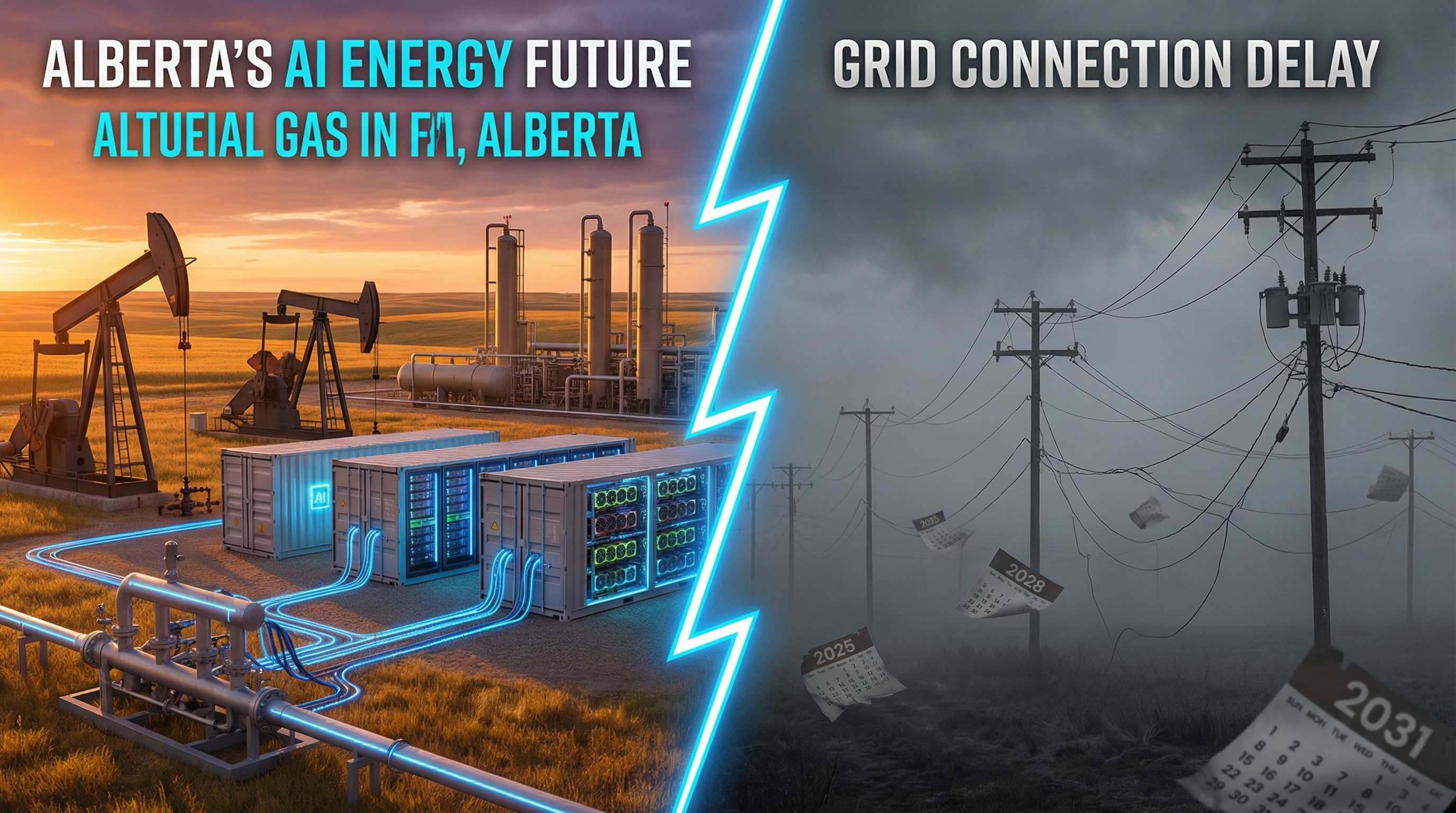
Alberta O&G Companies Are Losing 5+ Years of AI Competitive Advantage Waiting for Grid Power
Behind-the-Meter Natural Gas Generation Fixes This in 18 Months
Here's the math no one is talking about.
The Alberta AI Power Crisis in Plain Numbers
The AI data center boom in Alberta isn't slowing down — it's accelerating past what the grid can handle.
Right now, dozens of proposed data center projects are fighting over just 1.2 GW of available AESO capacity allocated in Phase I of their Large Load Integration Program. Total demand from data center projects in the interconnection queue? Over 20 GW. Alberta's entire peak grid load historically hovers around 12.4 to 12.7 GW. That means massive volumes of projects are stranded — approved in principle, capitalized, ready to build, but with nowhere to plug in.
If you're an Alberta oil and gas company watching this unfold, here's what that means for you: waiting for grid power to run AI is not a strategy. It's a five-year competitive handicap.
The companies that figure this out in 2026 will own the AI productivity advantage for the rest of this decade. The ones that wait will spend those same years submitting AESO interconnection applications and watching their queue position slip.
Why the Grid Queue Is a Dead End for O&G AI Adoption
Alberta's electricity grid was not built for the compute density that modern AI workloads demand. A single GPU cluster running continuous inference can draw as much power as a small town. And the AESO interconnection queue — already overwhelmed by hyperscaler demand — now has a multi-year wait for new transmission-connected large loads.
For oil and gas operators looking to deploy AI for:
- Well log interpretation and formation analysis
- Production optimization and decline curve modeling
- Predictive maintenance on surface and downhole equipment
- Anomaly detection across SCADA and sensor networks
- Reservoir simulation and EOR planning
...waiting years for grid capacity is simply not an option. Your competitors aren't waiting. And they don't have to — because the power they need is already coming out of the ground.
Behind-the-Meter Natural Gas Generation: The 18-Month Shortcut
Behind-the-meter (BTM) generation means producing electricity on-site, directly from natural gas, without needing AESO transmission access. It's the only solution that lets Alberta O&G companies go from zero to operational AI compute in under 18 months.
Here's what a typical modular BTM deployment looks like:
| Phase | Timeline | Outcome |
|---|---|---|
| Site assessment and design | Month 1 - 3 | Feasibility confirmed, gas supply secured |
| Permitting and procurement | Month 3 - 6 | AER and municipal approvals, equipment ordered |
| Modular generation buildout | Month 6 - 12 | 1 - 10 MW generation installed and tested |
| GPU deployment and commissioning | Month 12 - 16 | AI workloads running on dedicated power |
| Full production | Month 16 - 18 | Optimized, stable AI operations at scale |
Compare that to the grid route: 3 - 5 years just to get an AESO interconnection approval — if you even get one.
What This Means for Alberta O&G Companies Right Now
This isn't a speculative technology play. The GPU hardware is commercially available. The gas supply is already flowing. The permitting process for BTM generation is well-understood in Alberta.
What's missing — and what Natgas Powered AI provides — is the integration layer:
- Matching gas supply with the right generation technology
- Designing modular AI factories that scale from 1 MW to 10 MW
- Managing AER permitting, emissions compliance, and electrical safety
- Deploying GPU infrastructure optimized for O&G workloads
- Operating and maintaining the full power-to-compute stack
We've built our entire business around closing the gap between gas at the wellhead and GPUs in the rack.
The Bottom Line
Every quarter you spend waiting for grid power is a quarter your competitors are using to train models, optimize production, and reduce operating costs with AI. The math is straightforward:
Alberta's natural gas is the most underutilized competitive asset in the AI infrastructure race. The companies that deploy it first — behind the meter, on their own terms — will set the pace for the rest of the decade.
Ready to stop waiting for the grid?
Contact us to learn how behind-the-meter natural gas generation can power your AI operations in 18 months or less.
Sources
- AESO (Alberta Electric System Operator). Large Load Integration Phase I Update. (June 2025). The AESO implemented an interim large load connection limit of 1,200 MW to safely integrate data centers without compromising grid reliability.
- AESO Data Centre Update (October 2025). AESO reported receiving requests exceeding 20,000 MW (20 GW) of data center load on their connection project list.
- Alberta internal load (AIL) peaked at roughly 12,785 MW in recent historical tracking.
- Legislative Assembly of Alberta. Utilities Statutes Amendment Act, 2025 (Bill 8). Received Royal Assent on December 11, 2025. This bill legally defines the "Bring Your Own Power" framework, prioritizing self-supplying data centers to protect grid reliability.
- Legislative Assembly of Alberta. Financial Statutes Amendment Act (No. 2), 2025 (Bill 12). Received Royal Assent on December 11, 2025. It introduces a levy on data centers 75 MW or larger, but reduces the levy to 1% for facilities that utilize self-generation arrangements.
- Alberta Utilities Commission (AUC). Rule 007: Applications for Power Plants. Following Bulletin 2022-04, the AUC implemented a streamlined 5-business-day checklist application for power plants equal to or greater than 1 MW and less than 10 MW.
- TransAlta Corporation. Third Quarter 2025 Results (November 2025) and AESO Large Load Projects Dashboard. TransAlta executed a Demand Transmission Service contract for 230 MW at Keephills Phase I, while GLDC secured 970 MW, exhausting the 1,200 MW Phase 1 limit.